
🔑 1. The Cast: Key Hardware Components and Their Roles
A complete **UPVC window** hardware system is a coordinated team of specialized components, each with a distinct mission.
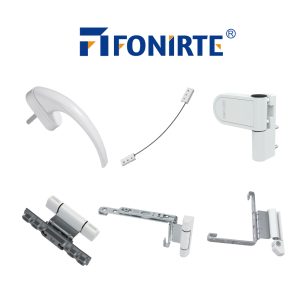
– **The Handle (执手):** This is your direct interface with the window—the part you touch every day. But it’s not just a grip; it’s a **gear mechanism** that transmits your motion to the locking system. Quality handles, like those specified for **FONIRTE windows**, feature **smooth rotational action** with precise detents that tell your fingers when the window is properly positioned.
– **The Hinges (合页/铰链):** These bear the entire weight of the sash and glass every time the window opens. Inward-opening windows typically use **scissor hinges** that slide along a track; outward-opening windows use **butt or friction hinges**. Both must be **corrosion-resistant** and precisely aligned to prevent sagging.
– **The Transmission System (传动器):** Hidden within the sash profile, this is the **mechanical backbone**—a series of connecting rods, gears, and corner drives that translate handle rotation into locking action. It’s the unsung hero that makes multi-point locking possible.
– **The Locking Points (锁点):** These are the **teeth of the system**. When you turn the handle to lock, hardened steel pins (lock points) engage with striking plates on the frame, pulling the sash tightly against the seals at multiple locations simultaneously.
– **The Keepers/Strikes:** The receiving plates on the frame that the lock points engage with. Their precise positioning determines **compression pressure** and seal effectiveness.
⚙️ 2. The Feel Test: What Quality Hardware Feels Like
You don’t need to be a technician to distinguish premium hardware from basic—your hands will tell you immediately.
– **Smooth, Consistent Resistance:** Turn the handle of a **FONIRTE UPVC window** slowly. The motion should feel **buttery smooth** with no grit, no sticking points, and no sudden changes in resistance. The mechanism should glide through its range with a **quality damped feel**.
– **Positive Engagement:** When the handle reaches the closed/locked position, you should feel a **clear, solid detent**—a slight click or resistance that confirms the locking points have fully engaged. There should be no vague “halfway” feeling.
– **Silent Operation:** Quality hardware operates **quietly**. No rattles, no squeaks, no metallic grinding. The sound of closing should be a **solid, muffled thud**—not a clatter.
– **No Play:** When the window is closed and locked, grasp the handle and try to wiggle it. There should be **zero looseness or free play**. The connection between handle and transmission should feel absolutely solid.
🛡️ 3. The Durability Promise: Materials That Defy Time
Hardware lives in a harsh environment—exposed to temperature swings, humidity, and constant use. Quality materials are the only defense against degradation.
– **Surface Protection:** Premium hardware, like that used in **FONIRTE window systems**, features **multilayer electroplated finishes**. This isn’t just for shine—the plating creates a **barrier against corrosion**. Look for hardware rated for **professional-grade salt spray testing** (typically 96+ hours), indicating it won’t rust even in coastal or industrial environments.
– **Base Metal Quality:** Beneath the plating, the base metal matters. High-end hardware uses **zinc alloys or stainless steel** for components that must bear loads, and **hardened steel** for locking points that must resist sawing or forcing.
– **The 10-Year Promise:** While the **UPVC profile** itself is virtually immortal, hardware sees mechanical wear. Quality systems are designed for **100,000+ operating cycles**—that’s 10 openings per day for 27 years. With basic maintenance (a drop of silicone lubricant annually), **FONIRTE-specified hardware** delivers smooth operation for decades.
– **Visible Signs of Quality:** On premium hardware, look for:
– **Deep, even plating** with no thin spots or discoloration
– **Laser-etched brand logos** (not stickered)
– **Precise fit** into the profile with no oversized cutouts
– **Screw heads** that sit flush and are corrosion-resistant
🔧 4. Integration: Hardware Designed for the Profile
The best hardware in the world will underperform if it’s not perfectly matched to the **UPVC profile** it lives in.
– **Eurogroove Compatibility:** Most modern **UPVC windows** use the **Eurogroove standard**—a specific channel cut into the profile that accepts standardized hardware components. This ensures that handles, hinges, and locks from different manufacturers can work together.
– **Reinforced Fixing Points:** **FONIRTE profiles** feature **localized reinforcement** at hardware fixing points—either through thicker profile walls or strategic placement of the steel liner. This ensures screws bite into solid material, not just thin plastic.
– **Concealed vs. Exposed:** Premium systems, like the **FONIRTE 98105-Series**, use **fully concealed hardware** where the transmission and hinges are hidden within the profile chambers. This protects the mechanics from dust and enhances the clean exterior appearance.
– **Adjustability:** Quality hardware includes **adjustment capabilities**—usually via Allen key—allowing fine-tuning of sash alignment, compression pressure, and hinge position years after installation as the building settles.
Final Insight: The Interface You Touch Every Day
Your **FONIRTE UPVC window** is a masterpiece of material science and precision engineering. But the part you interact with most—the hardware—deserves special attention. It’s the difference between a window that merely exists and one that’s a **pleasure to use, every single day**.
When you turn that smooth handle, feel that solid lock engagement, and hear that satisfying thud of closure, you’re experiencing the result of **decades of hardware engineering**. It’s the heart of your window—and in every **FONIRTE** system, it beats with precision.
FONIRTE – Hardware That Feels as Good as It Looks. 🔩❤️


