
Professional installer using a laser level on a FONIRTE UPVC window frame.
This is the “technical half” of the window’s performance. In the industry, we often say, “A high-end window with a poor installation is just an expensive draft.”
To optimize this for Google SEO, I have restructured the content to target “how-to” and “quality standard” searches. I’ve also added a “Red Flag” section, as users often search for signs of bad workmanship.
UPVC Window Installation: Why Professional Precision is 70% of Performance
You can buy the most energy-efficient UPVC window profiles, but if the installation is flawed, the window will fail. In the industry, we follow the “30/70 Rule”: 30% of a window’s performance comes from the product, but 70% comes from the installation.
Here is the professional roadmap to a perfect FONIRTE installation and why every millimeter matters.
1. The Foundation: Level, Plumb, and Square
Before a single screw is driven, the positioning must be flawless. A frame that is “close enough” is a frame that will fail.
-
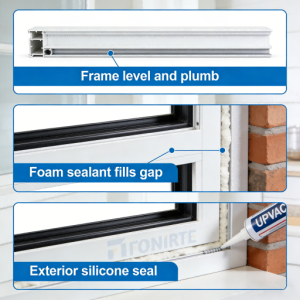
The Non-Negotiables: The frame must be perfectly Level (horizontal) and Plumb (vertical). Even a 2mm deviation can lead to:
-
Binding Sashes: Windows that scrape, stick, or won’t lock.
-
Seal Failure: Uneven pressure on gaskets, leading to air and water leaks.
-
Hardware Fatigue: Excessive strain on hinges and rollers, shortening their lifespan.
-
-
The FONIRTE Standard: Professional installers use laser levels and precision shims to create a perfectly square geometry. The visual test? When the window is closed, the gaps between the sash and frame must be uniform on all four sides.
2. The Critical Seal: Expansion Foam & Weatherproofing
The gap between your UPVC frame and the wall is a “living” joint that must handle thermal expansion and contraction.
Polyurethane Foam: The Flexible Insulator
We never use rigid materials like cement to fill gaps. Instead, we use high-quality expanding polyurethane foam.
-
Thermal Cushion: It expands to fill every void, creating an airtight, insulated barrier.
-
Movement Absorption: UPVC expands in heat and contracts in cold; the foam acts as a flexible cushion to prevent the frame from warping.
-
Application Tip: Foam must be applied in controlled layers to avoid “bowing” the frame from over-expansion.
The Exterior Defense: High-Performance Sealant
The exterior “bead” of silicone is your primary defense against driving rain. It’s not just for aesthetics—it’s a structural water barrier. It must be high-modulus, UV-resistant, and tooled perfectly to ensure a permanent bond.
3. System Integration: Setting Blocks & Hardware Tuning
A window is a machine with moving parts. A “complete system” approach ensures those parts work in harmony.
-
Glass Setting Blocks: The glass unit (IGU) never sits directly on the UPVC. We use specialized setting blocks to distribute the weight of the glass evenly, preventing stress cracks and ensuring the frame stays square.
-
Hardware Micro-Adjustments: Once the foam has cured, the hardware (hinges and locking points) receives a final “fine-tuning.” This ensures the sash meets the seals with uniform compression across the entire perimeter.
-
Certified Expertise: FONIRTE supports a network of certified installers trained in expansion gap calculations and specific reinforcement requirements for large-span openings.
🚩 Red Flags: How to Spot a Bad Installation
If you see these signs during or after your window replacement, the installation may be compromised:
-
Visible Gaps: Light or air coming through the edges of the frame.
-
Uneven Reveal: The gap between the sash and the frame is wider at the top than the bottom.
-
“Self-Closing” Windows: If you open a window halfway and it swings open or shut on its own, it is not plumb.
-
Messy Silicone: Gaps or bubbles in the exterior sealant.


